
Read More
 By Santo Rabidas
  Published 2026-08-10 07:36:21
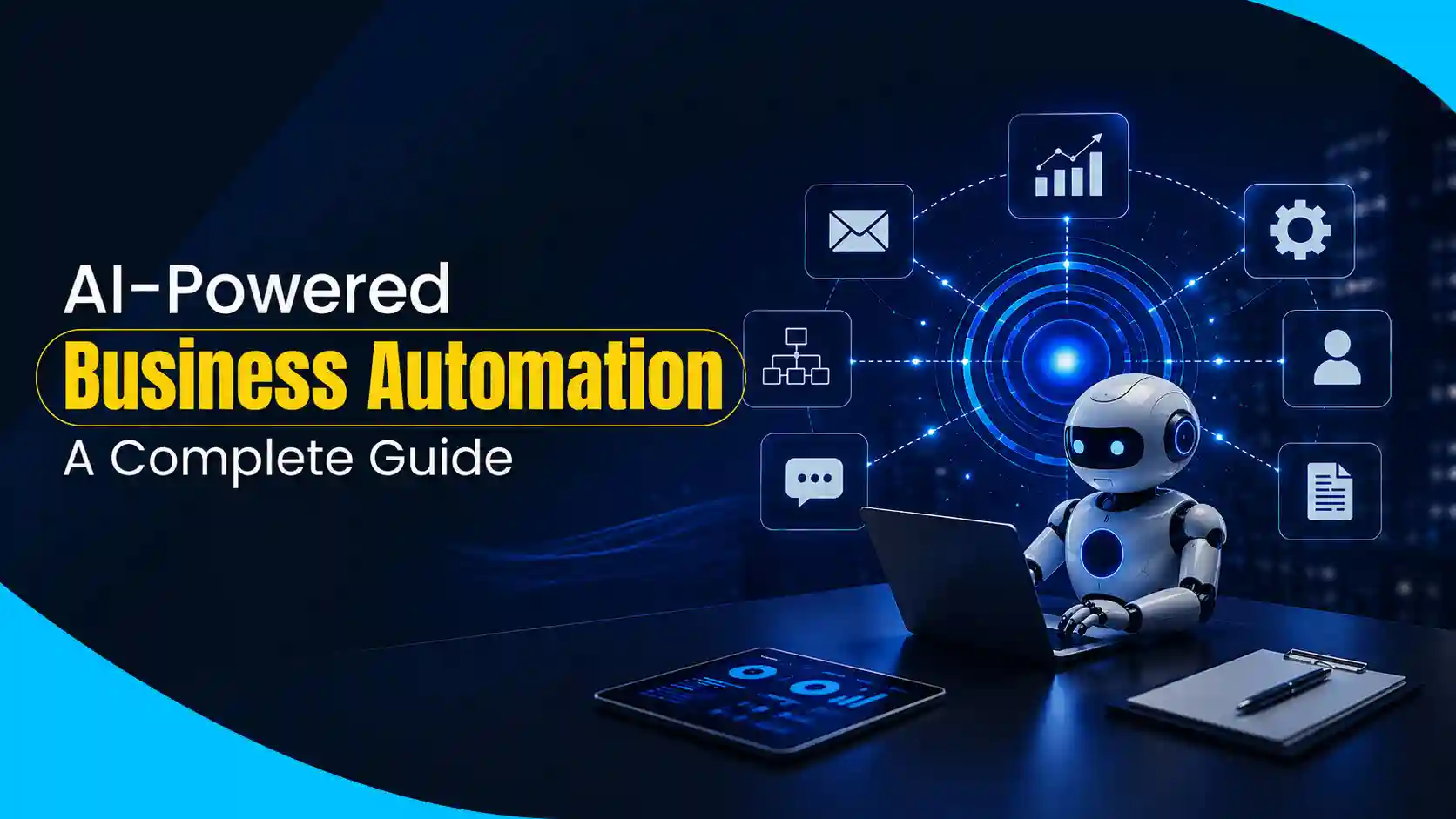
AI-powered business automation involves carrying out business activities through efficiency improvements, cost reductions, and increased productivity. Companies use AI technology for the automation of their activities, decision-making, and analysis of data to ensure efficiency and maintain high standards of customer experience. It can be used in any field such as marketing, sales, customer service, or finance. In this blog, you will learn about AI business automation.
AI-powered business automation means the use of AI technologies. These AI technologies include machine learning, natural language processing, and computer vision. The use of these technologies is made for the performance of repetitive tasks, reading unstructured data, and natural language processing. Computer vision technology helps in automating, monitoring, and optimising the work processes that require little human assistance.
Some of the key technologies include:
Machine Learning (ML)
The software learns from its experience in order to make predictions and find anomalies in its work without the involvement of any programming.
Natural Language Processing (NLP) and LLMs
Computers understand and process natural human languages. It is achieved by reading, analyzing, and producing human text in order to make chatbots, summarize emails, and analyze customer emotions.
Computer Vision
The software analyzes images and videos in order to conduct quality assurance and keep inventory.
Document Understanding
It is a technological advancement that enables scanned documents and PDFs to be processed automatically.
Robotic Process Automation (RPA)
Digital bots perform repetitive and rule-based desk tasks such as data entry using different applications.
Generative AI
Advanced transformer models generate new content, synthesize reports, and form autonomous workflows.
Listed below are some of the key benefits of automating business with AI:
Improves Business Productivity
AI-powered business automation helps achieve business efficiency by completing routine and repetitive business tasks. It includes data entry, invoice processing, schedule management, reporting, and document management. This saves manual labour and gives current employees an opportunity to concentrate on strategically important, creative, and customer-related activities. It involves solving problems, creating new ideas, and establishing customer relations.
Reduces Operational Costs
Automation reduces business operational costs by streamlining workflows, reducing manual labor, minimising errors, and enhancing resource utilisation of facilities and materials. This helps to avoid excessive duplication of administrative roles. Minimising labour involved in routine tasks of employees can lead to reduced business expenses and staff overhead while improving overall efficiency in all operations.
Increases Accuracy and Reduces Errors
AI helps with routine tasks through its predefined rules and machine learning models. This reduces typing mistakes, calculation errors, and inconsistent records. This leads to improved compliance, enhanced data quality, and better business performance. However, the role of humans is still necessary for making informed decisions.
Supports Better Decision-Making
Automating tasks for the business with AI analyse large amounts of data in real-time to identify patterns, make insights, and give predictions. This allows business leaders to make informed decisions and respond effectively based on the current requirements of the customer and changes in the market.
Enhances Customer Experience
AI chatbots, virtual assistants, and automated customer service systems give instant responses to common customer queries, eliminate waiting time, and maintain consistent support. So, people will have the ability to focus on complicated matters and improve customer satisfaction.
Enables 24/7 Operations
AI systems can perform various tasks continuously. Automation enables a business to automate services, order management, and workflows that monitor a 24/7 business. Businesses can automate customer support, monitoring, order processing, fraud detection, and workflow management around the clock. This brings customer support, process flow management, workflow procedures, etc on a round-the-clock basis. It helps to improve service availability and reduce operational delays.
Improves Data Analysis
The system of artificial intelligence analyses large amounts of structured and unstructured data. This is to find out trends, customer preferences, and operational challenges. These insights could be used to optimise products, marketing strategies, and business planning.
Strengthens Fraud Detection
AI constantly checks all transactions and user behaviours to identify any kind of suspicious activity in real time. The timely detection of possible fraud enables companies to reduce their losses, enhance security, and increase risk management.
Improves Scalability
Organizations can use this automation to handle large amounts of workloads without a need for proportionally increasing staff or operational complexity. This helps to maintain efficiency and service quality for business growth.
Optimizes Supply Chain
The use of artificial intelligence helps to analyse demand forecasts, inventory levels, supplier performance, and logistics data to improve supply chain planning. This will help prevent stock shortages, avoid overstocking, lower costs, and improve delivery performance.
Increases Employee Satisfaction
Artificial intelligence automates repetitive administrative tasks for employees. It also allows them to concentrate on innovation, problem-solving, collaboration, and higher-value responsibilities. This leads to skill development and improves workplace satisfaction.
Creates Competitive Advantage
Businesses that use AI will be able to adapt to market changes, improve operational efficiency, provide better customer experiences, and make smarter strategic decisions. This will enhance their competitiveness for sustainable growth.
Here are the key areas to use AI automation in Business. Some are mentioned below:
Customer Support Automation
Customer service is considered as one of the most common sectors that implement AI-based automation techniques. Artificial intelligence chatbots are capable of responding to customers' common questions, offering quick support, and assisting customers at any time. This helps human employees concentrate on complicated issues. Many firms use AI-based customer service systems.
Marketing and Sales Automation
Businesses can use AI automation to understand consumer behaviour and create effective marketing strategies. This means it can analyse consumer data, recommend products, improve email campaigns, and identify new consumers. Automated sales software assists sales teams in identifying better leads and making proper predictions.
Business Process Automation
This automation is used in many companies to handle office activities like data entry, document management, scheduling, and workflow management. Automated platforms connect various applications, reduce errors, and allow workers to accomplish their tasks quickly. These platforms help businesses create automated workflows between different apps and services.
Data Analysis and Decision Making
Businesses receive large amounts of collected data daily. Through analysis of this data, the firm can find various patterns and give useful insights. Such insights will assist companies in several aspects such as understanding customers, improving products, managing costs, decision-making, and so on.
Human Resources Automation
AI-powered business automation can automate tasks for HR teams. The tasks include resume screening, answering employee questions, interview scheduling, and employee data management. So, HR professionals can save time and focus on improving the employee experience.
Finance and Accounting Automation
AI automation can assist finance teams with invoice processing, fraud detection, expense tracking, and financial reporting. This reduces manual work, which helps businesses to improve accuracy and complete financial tasks. Business automation solutions also help to improve processes and reduce errors with the help of intelligent automation.
Supply Chain and Inventory Management
Companies that use AI solutions will be able to predict demand, manage inventory levels, and improve delivery planning. Businesses will also be able to avoid stock shortages, reduce waste, and improve supply chain efficiency.
IT Operations and Cybersecurity
It constantly monitors the business systems, identifies cybersecurity threats, detects unusual activities, and automates routine IT maintenance. This leads to system security, reduced maintenance time, and allows response of businesses to respond to potential cyberattacks.
Document and Workflow Automation
AI helps with preparing documents, invoice processing, data extraction, contract review, approvals, and digital workflows. This reduces paperwork, saves time by speeding up internal processes, and improves overall business efficiency. It results in greater efficiency and document accuracy.
Business Intelligence and Data Analytics
Every business creates large amounts of data daily. AI analyses this data to find patterns, customer preferences, market trends, and business opportunities. Such an analysis helps leaders to make the right decisions based on real-time information rather than assumptions.
AI-powered business automation gives businesses an opportunity to increase efficiency, reduce human involvement, save time, and so on. Businesses will be able to focus on growth and customer satisfaction. This happens because AI technology helps businesses automate their processes. If you want to know more about it, get in touch with FastInfo Hub.
FAQ
Q1. What is AI-powered business automation?
AI-Powered business automation is the implementation of Artificial Intelligence in business activities. This is used to automate routine tasks, processes, analysis, and decision-making with the minimum involvement of a human.
Q2. How does AI-powered business automation work?
This is achieved through the combination of technologies like machine learning, natural language processing (NLP), robotic process automation (RPA), and predictive analytics. These are used for performing tasks and making business processes more efficient.
Q3. What are the key benefits of AI-powered business automation?
The key benefits include increased productivity, lower operational costs, better decision-making, decreased mistakes, improved customer experiences, and scalable business operations.
Q4. Which business processes can AI automate?
The list of processes that could be automated with AI includes customer support, lead management, email marketing, accounting, HR tasks, inventory management, document processing, scheduling, reporting, sales forecasting, and so on.